
Filters


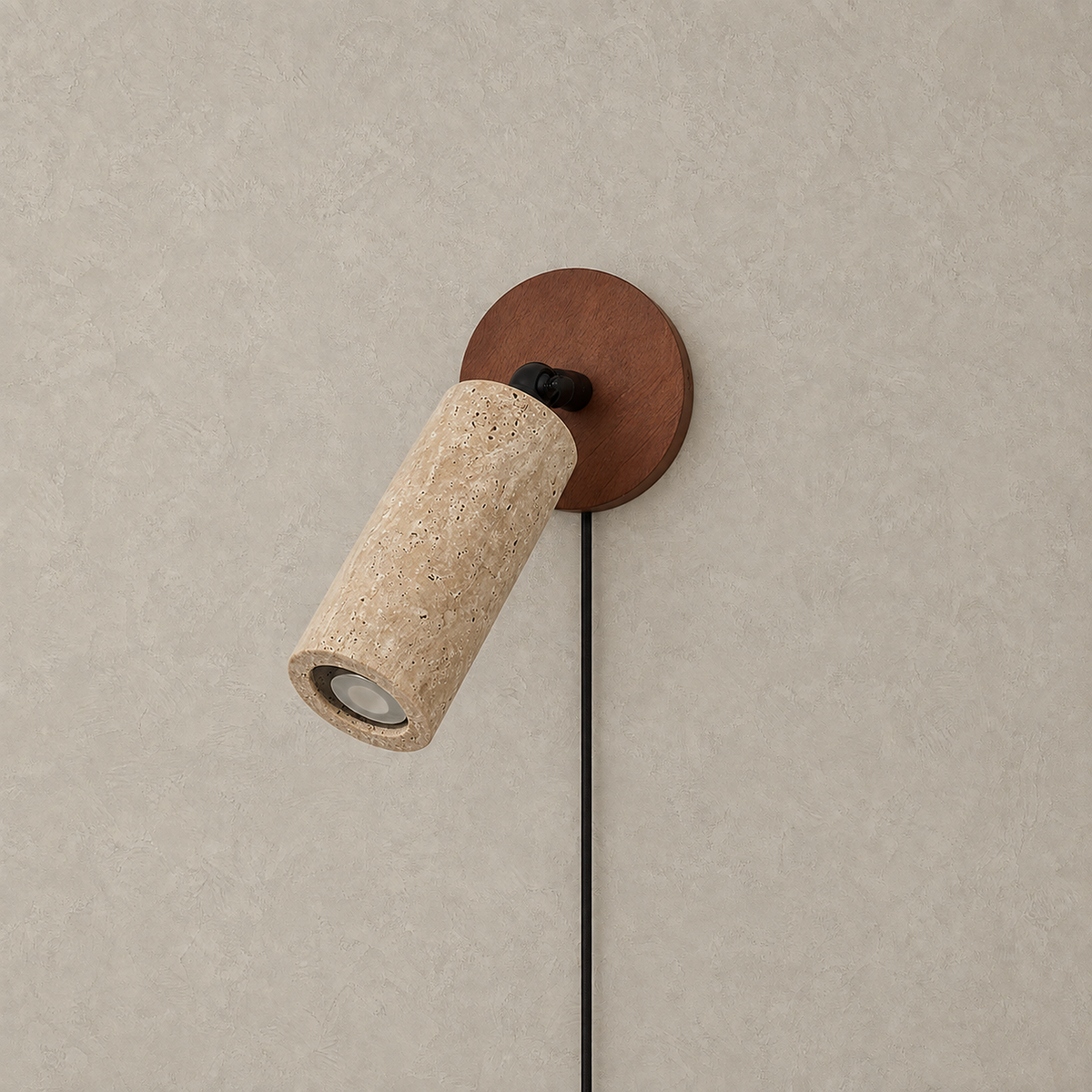



What plugging in decides for you
Hardwiring hands a fixture to an electrician and fixes it to a spot on the circuit. Plugging one in hands the decision back to you, and hands you a cord along with it. That is the whole trade, and it is worth looking at squarely before you pick on looks.
What you gain is placement. A wall with no wiring behind it becomes usable. A rented flat becomes usable. You can take the thing with you. They come with a US plug, so they go straight into an ordinary outlet here.
What you take on is a visible cord and the job of putting it somewhere sensible. Nobody solves that for you.
The cord is the measurement that matters, and almost nobody prints it
If the outlet is four feet from where you want the light, a three foot cord is not a small disappointment. It is the wrong product.
Very few manufacturers publish a cord length. The ones that do say 59 in (150 cm), a touch under five feet. The rest say nothing at all, and where the maker does not state it we are not going to invent a number. So the honest advice is to measure from the outlet to the spot on the wall and add slack for the drop.
The same silence covers how far a sconce stands out from the wall. It is printed even less often than the cord. On a hallway wall people walk past, a figure like 2.6 in (6.5 cm) is what decides whether a fixture is charming or something you catch a shoulder on, and many listings leave you to guess at it.
Many of these take a bulb you choose
Across our other wall sconces the light is built in and settled at the factory. Here it often is not. Many of these take a replaceable bulb, in an E26 or E27 screw base, a small G9 capsule or an E12 candle base. The others have the LED built in.
That matters more than it sounds. When the bulb is yours, so is the color of the light, its brightness and what it costs to replace in five years. A warm 2700K bulb and a cool 4000K bulb in the same fixture make two different rooms. The bulb models do not usually arrive with a bulb in the box; the product page says, so budget for one where it does not.
The built in LED ones settle all of that for you, and cannot be changed later. Neither answer is better. They are different bets on who should decide.
Where the switch sits
Many of these switch on the cord, so the light turns on somewhere between the fixture and the floor. The rest switch at the fixture itself, by a knob on the socket, a button on the body or a pull chain.
Beside a bed that difference is the whole experience. A cord switch you can find in the dark while lying down. A knob on the fixture means sitting up and reaching for it. Neither is a fault; they are different habits, and it is worth knowing which one you are buying.
On dimming the answer is mostly silence. A few state plainly that they do not dim. A couple offer it on particular versions. The rest say nothing, and a fixture that does not mention a dimmer usually does not have one. If you want to dim a bulb model, that runs through a dimmable bulb and a plug in dimmer, not through the sconce.
Some of them also move
A good number of these adjust: a head on a pivot, a shade that rotates, an arm that folds. If aiming the light is the reason you are shopping rather than simply getting light onto a wall, the adjustable sconces are a narrower and more useful list, and it includes hardwired and cordless fixtures this page cannot show you.
Some of the fixtures here can also be wired in instead of plugged in, sold either way. If the wall does have a circuit behind it, those give you the choice without changing the fixture.
When a cord is the wrong answer
Sometimes the outlet is on the far wall, or there is no outlet, or a cord across a doorway is not something you will accept. That is not a problem to solve with a longer cord. A cordless sconce removes the cord entirely and asks you to charge it instead, which is a different chore rather than a smaller one.
None of these is for a bathroom or anywhere damp. Where a rating is printed at all it is IP20, which means indoor and dry. A plug in fixture near water is a second problem on top of the first, because the outlet has to be somewhere too.