
Filters






Three questions, and then taste
Most people arrive at a page like this with the same three questions in the wrong order. Style first, then size, then a late discovery about wiring that sends them back to the beginning.
The order that works is the reverse. How will it get power. What does the light have to do. Where in the house does it go. Answer those three and a long grid becomes a handful, and only then are you choosing on looks, which is the enjoyable part.
Power first, because it is the only one you cannot undo
There are three answers and no fourth. A rechargeable battery. A cord to an ordinary outlet. Wiring into a house circuit.
The difference is not a feature list, it is a decision about the wall. A battery fixture goes up with screws or adhesive and nothing else, so it can take a fireplace wall, a rented wall, or a landing with no wiring anywhere near it. A plug-in needs an outlet within about five feet and leaves a cord on show unless you chase it into the wall. A hardwired fixture needs an electrician once and then behaves like every other light in the house: on the wall switch, with nothing to recharge.
If the wall has no wiring and you would rather not open it, start with the cordless ones and let the rest follow from there.
What the light actually has to do
Four jobs cover nearly all of it, and a fixture that is excellent at one is usually poor at another.
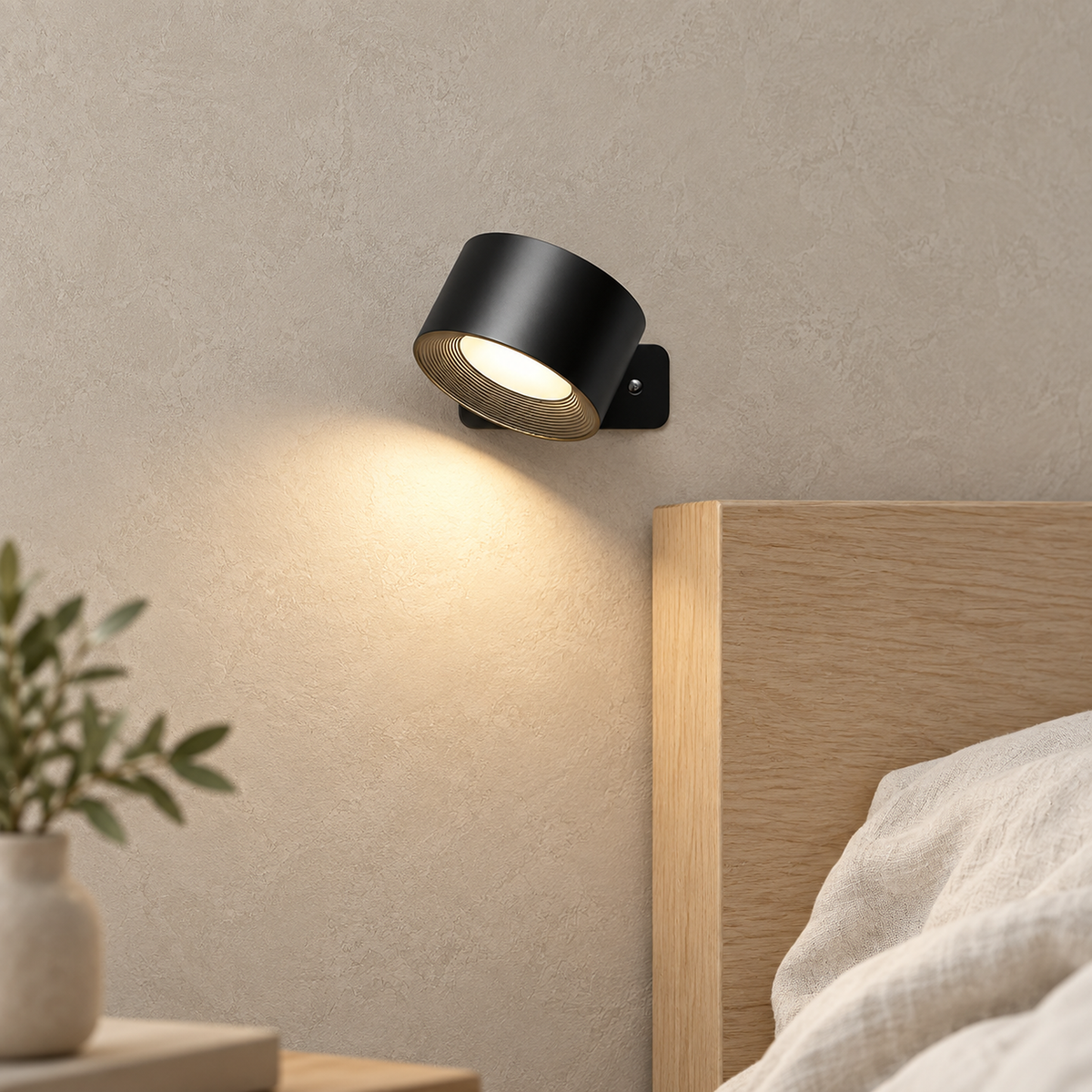
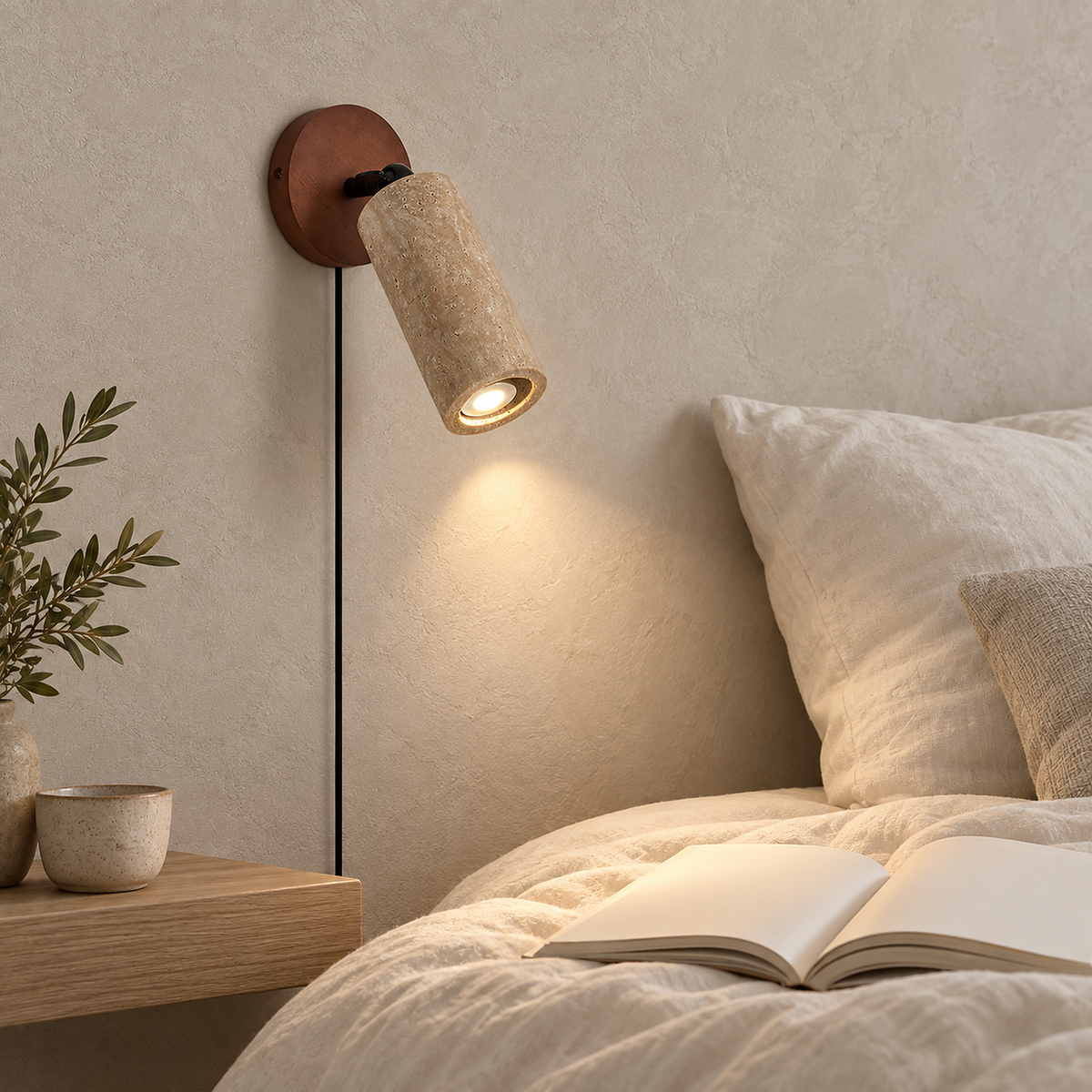
Reading. Some of these aim: a head on a pivot, a shade that rotates, an arm that moves. Small and low in wattage on purpose, because a beam on a page beats a bright room. That is the adjustable end of our wall sconces.
Ambient light on a wall. The linear bars and rods lay a band of light on the wall rather than throwing it into the room. These are the ones that make a room read as larger and let you leave the ceiling light off.
Art and mirrors. A few are specified for artwork or a mirror, and they are linear bars as a rule, because a picture light is a bar you mount above the frame and aim down across it.
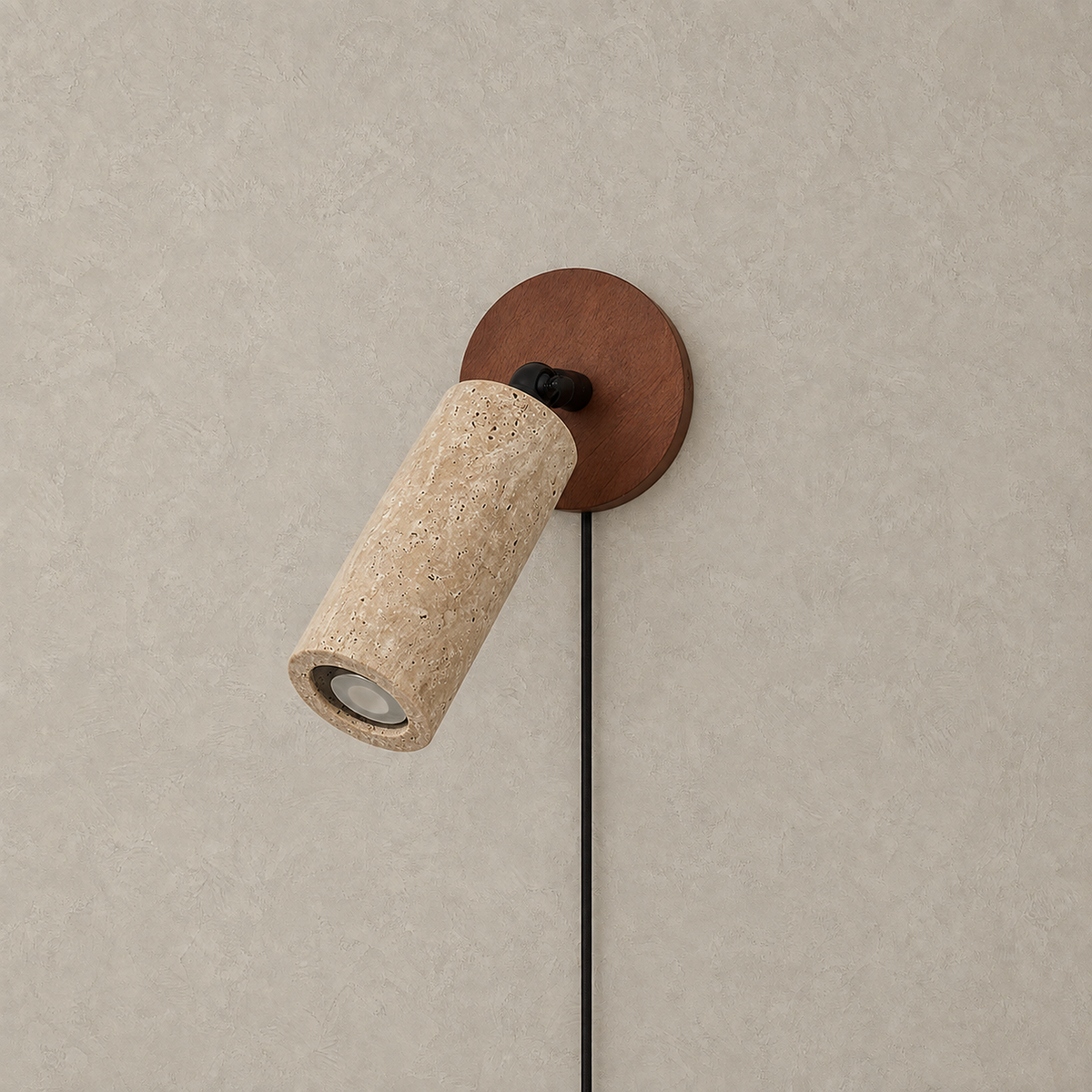
Being the object. The rest are there to be looked at: marble, travertine, ceramic, faceted crystal, a collapsible lantern, a panel that glows like a sunset. They all give light, but the reason to buy one is the thing on the wall.
Some of them do something the others do not. They switch themselves on when someone walks past, which is a hallway and landing problem rather than a lighting one.
Bulb, or no bulb
Many of these have the LED built into the fixture. Others take a replaceable bulb, and the light source line on the product page says which.
Built in means a thinner body, a light color settled before it ships, and nothing to replace when it eventually fails, because the fixture is the unit. A socket means you pick the bulb, you can change the color later, and you can replace it on its own. Neither is better than the other. It is worth knowing which you are buying, because a photograph will not tell you and it decides what happens in ten years.
Where in the house
Many of these suit more than one room, which is why the room collections overlap rather than divide. Much of what is here is listed for a bedroom, which makes that the page to open if you have not narrowed anything down yet. Many are listed for a hallway, and many for a living room, where the job is usually layering rather than reading.
The room matters less to the fixture than to the height. A bedroom sconce is mounted for someone lying down, a living room sconce for someone sitting, a hallway sconce for someone walking past. The same fixture, three different marks on the wall, and the room pages carry the measurements.
Some of the groupings here cut a different way. Modern gathers the reduced forms with the LED hidden inside them, Black gathers everything available in that finish, and Brass gathers the warm metal. Those answer a question of taste rather than of job.
Some of these come as a pair
Sconces are often bought two at a time, either side of a bed or flanking a mirror, and some here are sold that way: two or more fixtures in one box at one price. On some the title says Set of 2; on others the set is one of the choices in the product's options, and the price follows the pack you pick. Everything else is a single fixture, so a pair means ordering it twice.
What the money buys
At the cheap end you are usually buying a battery fixture with no stone in it. At the top, the money goes into material and quantity rather than into light output: a travertine and wood fixture, a marble disc, a pair of lamps in one box.
A small reading light and a marble sconce are not competing for the same job, so the spread on this page says less about quality tiers than about which of the four jobs you are solving. Work out the job first and the price sorts itself out.
What is not here
Nothing on this page is meant for a bathroom, a damp room or an outdoor wall. Where a location is stated it is indoor and dry, and where a rating is printed it is IP20. If you need a light over a shower or beside a front door, this is the wrong page, and we would rather say so than sell you one.
Three things to settle before you order
How it gets power. That single decision narrows the page in one move, whichever way it goes.
Which of the four jobs it is doing. A picture light beside a bed and a reading head above a sofa are both mistakes, and both are easy to make from a photograph.
The height, measured against the person using it rather than against the wall. It is the most common thing to get wrong and the most tedious to put right.