
Filters


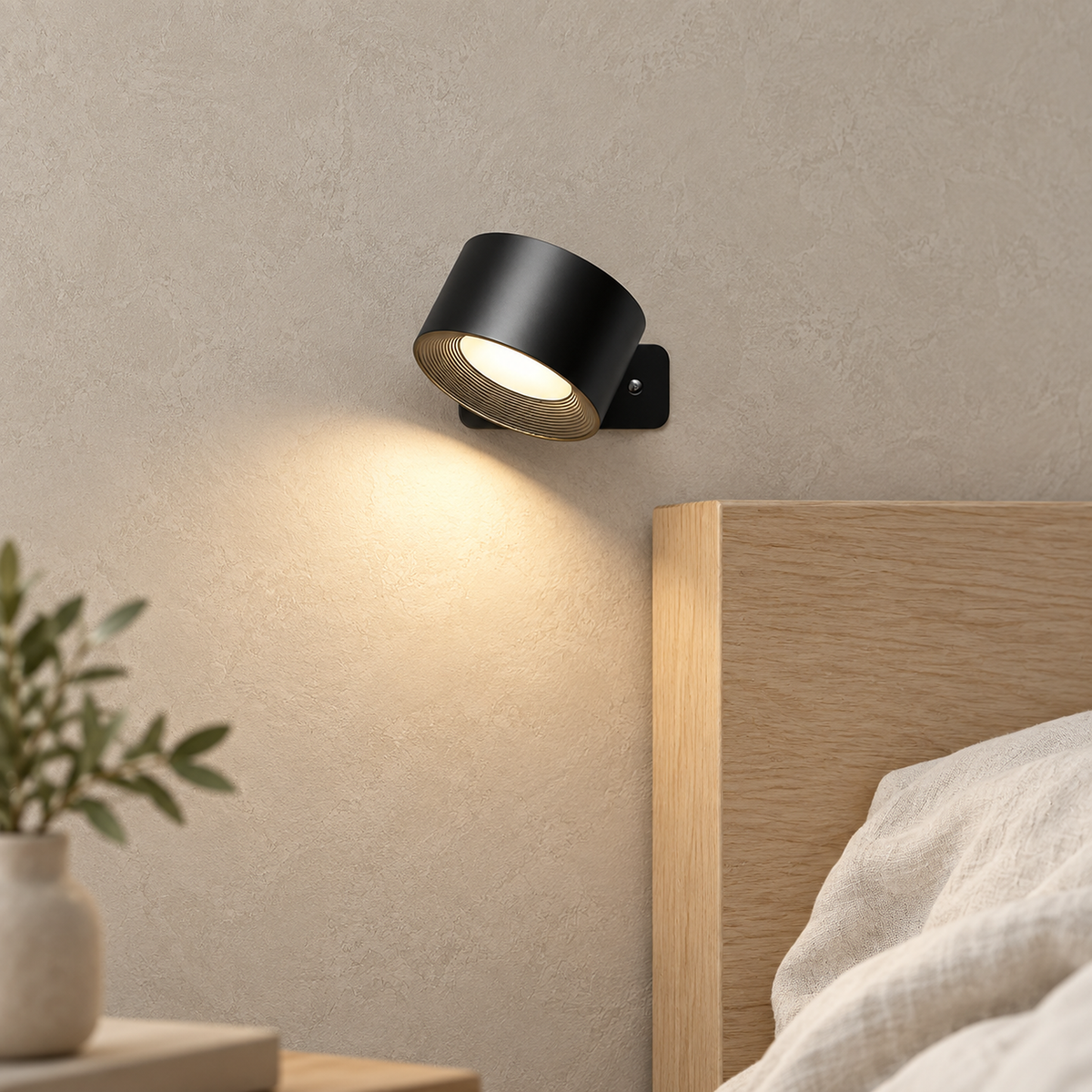


Putting one up takes a screwdriver, not an electrician
The usual arrangement here is a backplate or bracket that goes on the wall with the screws and anchors in the box, with the light clipping or twisting onto it. There is no junction box to find, no supply to isolate, nothing to connect. If you can hang a picture frame straight, you can hang one.
A few models skip the screws entirely and fix to the wall with an adhesive base, which needs a smooth, clean surface — painted plaster or tile, not textured wallpaper or bare brick. Where the manufacturer states the mounting method, the product page gives it, and it is worth checking, because it changes what you can do with it. An adhesive base is the difference between asking a landlord and not having to.
The other thing that disappears is the cord. A plug-in sconce still has to reach an outlet, and that cord either runs down the wall in view or gets hidden behind a cover. A battery sconce has nothing hanging off it, which is why they tend to look cleaner in photographs and why people put them in places an electrician would never have run a cable to.
Charging is a USB cable, and how often depends on you
Charging here is over USB as a rule, so a phone charger, a laptop port or a power bank will do it. Many come with the cable; the product page says how a given sconce charges and what is in the box.
How you charge depends on the design. Some sconces have a port on the body, so you plug in while the light stays on the wall. On others the head lifts off its base, and you carry just the head to wherever the cable lives. The second kind is easier if the sconce is mounted high or behind furniture.
How long a charge lasts is the question everyone asks, and the honest answer is that it depends on the model and how bright you run it. A small reading light on its lowest setting behaves nothing like a 1,500-lumen fixture at full output. Where the manufacturer states a figure, the product page lists it; we publish the figure we were given rather than a number that sounds good across the range.
What is consistent: dimming extends it, and warm light at a low level is how a sconce like this ends up being used anyway.
Renting, older buildings, and walls you would rather not open
Cordless is not only about convenience. It is often the only option.
If you rent, running a new circuit is not yours to authorize, and most tenancy agreements treat a junction box as an alteration. A battery sconce needs two screw holes, or none at all with an adhesive base, and it comes off the wall with you when you move.
The same applies to solid masonry, to older buildings where chasing a cable into the plaster means repairing the plaster afterwards, and to any wall where the nearest circuit is on the other side of the room. Bedside lighting is the common case: the bed ends up where the bed fits, which is rarely where the builder put a socket.
This is also why cordless sconces appear in pairs so often. Wiring two symmetrical points either side of a bed is a job. Mounting two lights is an afternoon.
Where they end up
Beside a bed is the first place most people put one, and it is what a lot of these fixtures are shaped for: light aimed down onto a book rather than out into the room, and a switch you can reach lying down.
Hallways and stairwells come next. They are the parts of a house with the least wiring and the most need for light at ankle height at two in the morning, which is why the motion-sensor models in this collection tend to end up there.
After that it is the places a cable was never going to reach: inside a wardrobe or a cupboard, above a picture, in a rented office, on a boat or in a camper, in a garden room without a supply. These are not compromises for a battery fixture. They are what it is for.
The switch, the color, and the remote
Many sconces here are controlled by a touch sensor on the body itself, a tap for on and off and a long press to change the brightness. Many also ship with a small remote, which matters more than it sounds if the light is above a bed or out of reach.
Color temperature is usually adjustable across three settings: warm white around 3000K, neutral around 4000K and cool around 6000K. Warm is what you want beside a bed. Cool is for a work surface or a mirror. Some fixtures are fixed at warm white; where the manufacturer states the color temperature, the product page gives it.
A few models add a timer that switches the light off after a set period, and a few use motion detection instead of a switch: they wake when you walk past and go dark again shortly after you have gone. A given fixture may not have each of these features. The specification list on each page is the reliable place to check.
What you give up
A battery sconce is not a like-for-like replacement for a hardwired one, and it is worth being straight about where it loses.
It has to be charged. That is the whole of it, and for most people it is a minor chore, but it is a chore a hardwired light does not have. If the light will be on for eight hours a day, every day, hardwired is the right answer.
Output is generally lower. The brightest fixtures here reach the same lumens as a mains sconce, but the small ones are ambient and reading light rather than room light, and where the page gives a lumen figure, read it rather than assume.
And on these designs the battery is built in rather than a cell you swap out, unless the product page says otherwise. Its life is the fixture’s life. Every sconce we sell carries a one-year warranty from delivery, and the terms are on the warranty page.
Before you buy, check three lines on the page
Look at the mounting method first: screws, adhesive, or either. That decides whether the wall you have in mind is a wall you are allowed to use.
Look at the lumens second, where the page gives them. It is the number that tells you whether the light will do the job, and it runs from a soft ambient glow at the bottom of this collection to enough output to light a whole corner of a room at the top.
Look at how it charges third, a port on the body or the head off the base. It is a small thing until the sconce is mounted above a headboard and the cable does not reach.
Everything else is style, and style you can judge from the photographs.