
Filters




The overhead light is not the problem you are solving
A ceiling light is good at one thing: filling a room evenly when you need to find something. It is poor at almost everything you actually do in a living room after dark.
Sconces are the second layer. They sit at the height people sit at, they throw light onto walls rather than down into the middle of the floor, and they leave the corners soft instead of flat.
The test of a room’s evening lighting is whether you can switch the ceiling light off and still be comfortable. If you can, the layer is doing its job.
Where they actually go
Four places cover the usual choices.
Either side of the sofa. This is the living-room version of a pair beside a bed. Each end gets its own light, and nobody ends up reading in someone else’s shadow.
Flanking something. A fireplace, a television, a wide mirror, a piece of art. A pair either side frames whatever sits between them, and the symmetry does most of the work.
On the wall that has nothing. Most living rooms have one — too narrow for furniture, too blank to ignore. A single sconce is often the cheapest thing that fixes it.
Beside a chair. Where someone reads. This is the one case where a living-room sconce has the same job as a bedside one, and the same answer: an arm that reaches out over the chair, rather than a fixed shade on the wall behind it.
Light on the wall, not in the room
This is the part people underestimate when they are choosing from photographs.
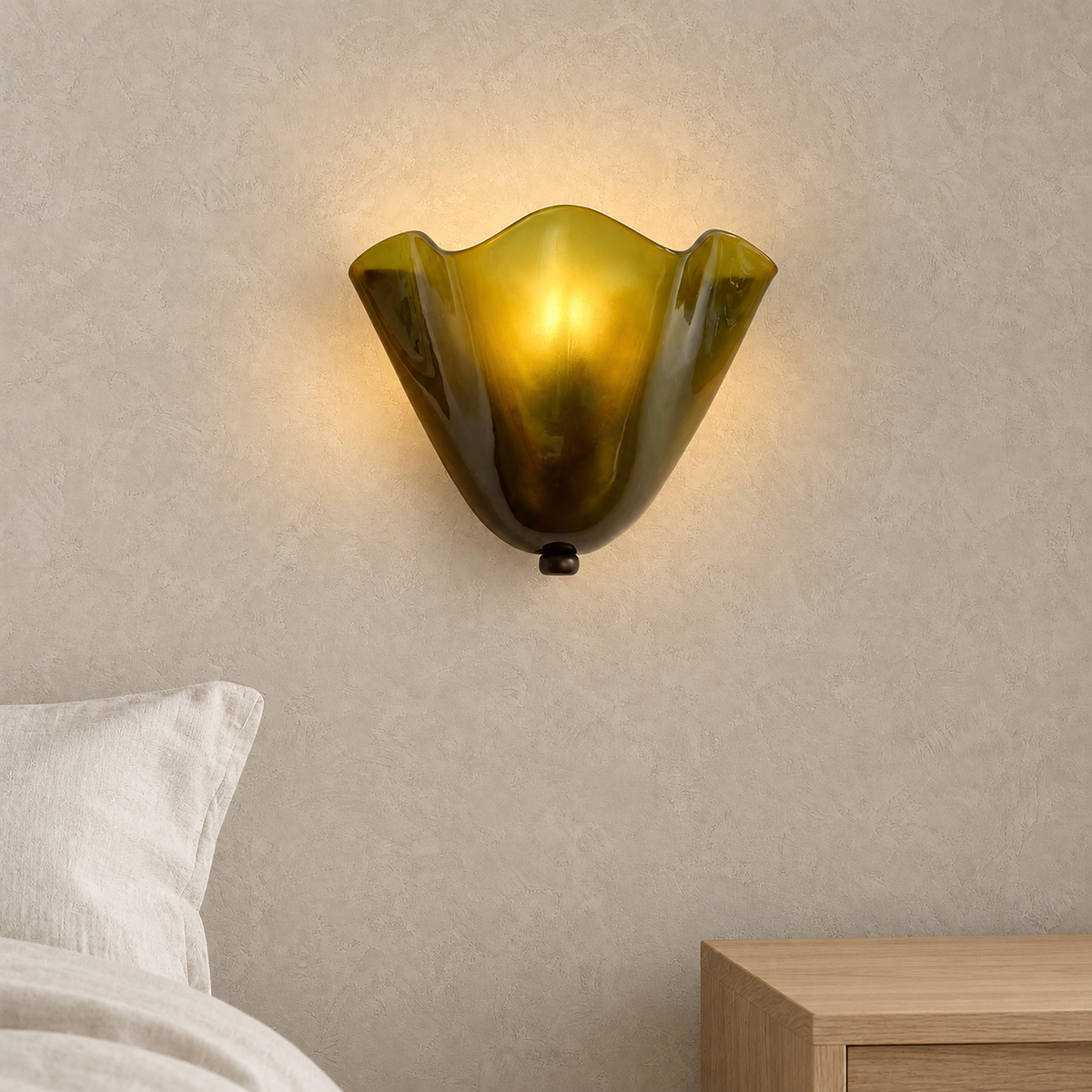
A sconce that throws light both up and down puts two soft pools on the wall above and below it. The wall becomes the light source rather than the fixture, and the room reads as larger than it is.
A wall-washing fixture does the same thing more deliberately, spreading an even sheet of light across the surface instead of two separate pools.
A shade that sends its light forward does the opposite. It lights the room rather than the wall. That is right beside a chair and wrong on a feature wall.
It is worth knowing which of the three you are buying, because in a photograph they look almost identical and in a room they do completely different things.
Art and mirrors
A large part of this collection exists for one job: putting light on something flat and vertical.
A picture light sits above the frame and aims down across it. What you are paying for is even coverage — no hotspot in the middle, and no shadow of your own head when you stand in front of it.
A mirror is the same problem inverted. The light needs to land on the face, not on the glass, which is why a mirror is usually better served by a pair at either side than by one fixture above it.
Dimming does more here than anywhere else
In a bedroom, dimming is a convenience. In a living room it is most of the value.
The room gets used across a whole evening, and it wants different light at seven than it does at eleven. A sconce you can take down to a quarter is a different fixture at each end of that evening. One that only switches on and off is the same fixture all night.
Many of these dim, by touch or from a remote, and some offer fixed steps rather than a smooth range. The specification on the product page says which, where the manufacturer states it.
Height is seated height
A living room sconce is not mounted at the height you stand at. It is mounted for people who are sitting down.
Beside a sofa or a chair that usually puts it a little above the back of the seat — high enough that the light clears a shoulder, low enough that the bulb is not in the eye line of anyone sitting across the room.
Flanking a fireplace or a television, the anchor is different: line them up with the thing they are framing, not with each other in isolation.
Before you buy, check two things
Which way the light goes — up and down, washed across the wall, or forward into the room. That decides what the fixture will actually do once it is up.
Whether it dims. In a room used from dusk until bedtime, that is the difference between a light you use all evening and one you switch on at the end.